Return to School
Emergency Protocol Training
ADEK Safe Education Protocol — mandatory training for all staff as a condition of school reopening. Complete all modules and the physical drill acknowledgment.
Presenters: click here to start the full-screen slide deck · Arabic speakers: click the green button to translate this page
Your Progress
0 / 9 completedContext: Why We Are Here
5 min — Understanding the directive and what it means for AISA
ADEK has directed all schools to resume face-to-face learning on Monday, April 20. As a condition of reopening, all teaching staff currently in the country must complete this emergency protocol training. ADEK will conduct a validation visit to verify readiness and issue approval.
Mandatory Training
Attendance is documented and submitted to ADEK
Validation Visit
ADEK visit window: Friday 8AM — Sunday 5PM
Physical Drill
A shelter-in-place drill follows this session
Key points: Bus services remain suspended (MOE directive). Parents are arranging private transport. Remote learning will be provided for students unable to attend — no hybrid classes. Parents must sign an undertaking to return students to in-person education.
ADEK Safety Protocol: 12 Core Principles
10 min — The foundational rules that guide every decision
Safety of students and staff is the highest priority
Stay inside protected buildings and facilities
Avoid windows, glass, and exposed areas
Move to internal and safe areas if needed
Immediate adherence to official instructions
Prevent crowding or uncontrolled movement
Reassure students; avoid panic or fear during alerts
No photos, publishing, or sharing unofficial info
Suspend movement, learning, dismissal during alerts
All external activities must be stopped
All staff must be trained on these procedures
Maintain readiness to suspend in-person learning
Operational Risk Levels
5 min — Green, Yellow, Red explained
GREEN
Low Risk / Stable
No alert messages. Normal operations. Classes held indoors. Readiness is enhanced. Morning assembly and outdoor activities are suspended.
YELLOW
Medium Risk
Classes continue during alerts with preventive measures. Stop movement and shelter immediately. Apply preventive actions.
RED
Direct Danger
Immediate shift to remote learning. Do not resume in-person education until official approval. Authorities determine levels based on location.
Stage Protocols: Arrival Through Dismissal
10 min — Four stages of the school day covered
1 Before Arrival
2 Arrival & Handover
3 Inside School
4 Dismissal & Return
Your Role and Responsibilities
10 min — What every teacher must be able to do
DO This
- Know your safe zone and route to reach it
- Guide students calmly and quickly to the safe zone
- Take headcount immediately — report missing students
- Keep students calm: steady voice, honest reassurance
- Watch for distress signs — refer to counselor
- Stay in safe zone until official all-clear
Do NOT
- Do NOT evacuate the building
- Do NOT allow students near windows or glass
- Do NOT take photographs or video
- Do NOT share anything on social media
- Do NOT contact parents individually
- Do NOT release students during an alert
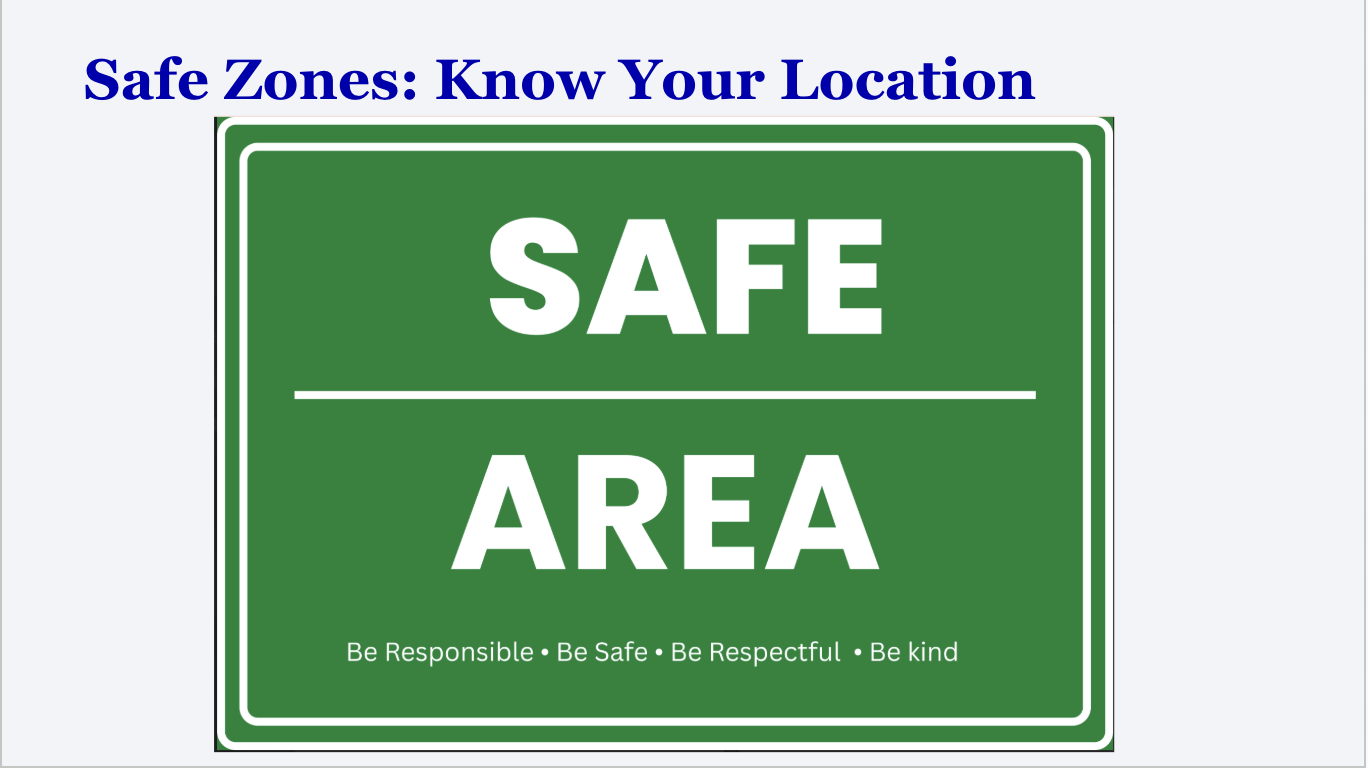
Safe Zones: Know Your Location
5 min — What makes a safe zone and what to expect
A designated interior space providing temporary protection during emergencies, away from external facades and windows.
Indoor Location
Away from external facades and windows
Structural Strength
Reduces impact and blast waves
Hazard-Free & Spacious
Fits all occupants safely
1-Min Access
Reachable within 60 seconds max
Clearly Marked
Identification signs visible and posted
Linked to Plan
Part of AISA's emergency protocol
Student Wellbeing During Emergencies
10 min — Emotional support strategies from ADEK
Regulate Yourself First
Take slow, deep breaths. Keep your voice steady and calm. Avoid panic. Students read adult body language instantly.
Gather and Reassure
Move students away from windows. Keep the group close to you and to each other. Use a smile.
Use Honest Words
"We are safe here together." "That was loud, but we are safe." Normalize: "It's okay to feel scared or surprised." Keep them engaged with drawing, storytelling.
Remote Learning Model & Monday Logistics
5 min — Hybrid rules and DL student support
DL Student Options
Option 1: Dedicated synchronous sessions scheduled separately.
Option 2: Exclusive asynchronous work — no live sessions required.
Option 3: Alternative model proposed to ADEK for approval.
Mandatory Check-ins
Minimum 15-minute group check-in with ALL distance learning students daily.
Elementary: Learning Support Team conducts check-ins (consider time zones).
Secondary: Counselors conduct check-ins (consider time zones).
The school will confirm the model and share details before Monday. ADEK PASS substitute pool available at pass@adek.gov.ae for staffing challenges.
Physical Drill & Acknowledgment
30 min — The hands-on drill that follows this session
Division leaders assign safe zones
You will be told your specific safe zone and shown it on the building map.
Walk the route
Physically walk from your classroom to your safe zone. Time it. Must be under 60 seconds.
PA system test
PA will be activated. Confirm you can hear it from your location.
Simulated shelter-in-place
Announcement made. Move to safe zone as if real. Sit low, away from windows.
Headcount and report
Use the red/green card system. Send "all clear", "missing ______", or "I have ____ in my class" in the Alert Attendance group.
All-clear and debrief
All-clear announced. Regroup. Discuss what worked and what needs adjustment.
Parent Acknowledgment
5 min — ADEK-required parent/guardian undertaking for return to in-person learning
ADEK requires that all parents or guardians sign an acknowledgment form confirming their child's return to in-person education.
This is a regulatory requirement, not an AISA policy, and applies to all private schools in Abu Dhabi. Your children cannot attend in-person learning unless they complete this form.
Students will turn in a physical paper to the front gate upon arrival.
We will have blank copies available for parents to fill out, if needed.
Knowledge Check
Verify your understanding of the critical protocol elements
1. During an alert, should you evacuate students from the building?
2. During an alert, can you contact parents to let them know their child is safe?
3. In GREEN operational level, which of the following is TRUE?
ADEK Reference Documents
Official documents provided by ADEK for this protocol
ADEK Circular — Gradual Resumption
PE/K12E2026/022 — Official directive for school reopening
Safe Education Protocol — Full Training
Operational protocol for protecting students and continuity of in-person education
Inspection Checklist
11-point compliance checklist for ADEK validation visit
Parent/Guardian Undertaking
Declaration form for parents to consent to return to in-person learning
Education Entity Undertaking
School declaration of compliance signed by principal
AISA Emergency Training Presentation
Full training slide deck with speaker notes
Training Acknowledgment Form
Complete this form to confirm your attendance and understanding of the emergency protocol
Scan to open on your phone
Or open the form directly in a new tab:
Open Acknowledgment FormCore Roles — Quick Reference
Incident Lead
Andrew Torris
Backup: Kevin Fosburgh
Communication Lead
Engy
Student Wellbeing Lead
Lisa Jones
Health & Safety / Operations
Adarsh
ES Division Leads
KG: Stephanie Brown | Lower ES: Kevin Fosburgh | Upper ES: Alia Nejdawi
Secondary Division Leads
MS: Savvas Largatzis | HS: Cristina Martin